
Home > News > Other news > Other news
Cationic Starch as a Fixing Agent: How to Significantly Improve Color Fixation on Paper
- Release date:26-04-23 13:54
- Number of clicks:54
Cationic Starch as a Fixing Agent: How to Significantly Improve Color Fixation on Paper
In the production of high‑quality colored paper – such as baby paper products, cigarette paper, and food packaging paper – both color appearance and safety are critical. Many traditional synthetic dyes and fixing agents contain toxic substances (heavy metals, phenols, formaldehyde) that are harmful to human health and the environment.
A more sustainable solution exists: cationic starch as a fixing agent for edible dyes. A recent study published in China Pulp & Paper (Vol. 38, No. 3, 2019) by Chen Tong et al. demonstrates that cationic starch can dramatically improve the fixation of indigo blue (an edible pigment) on paper. Below we summarize the key findings and provide actionable process parameters for paper manufacturers.
Why Cationic Starch Works as a Fixing Agent
Paper fibers naturally carry a negative charge. Most edible dyes (e.g., indigo blue, azo‑type acid dye) are also negatively charged. As a result, without a fixing agent, the dye does not adsorb well onto the fibers – the color washes off easily.
Cationic starch is produced by etherifying starch with a cationic reagent, introducing positively charged ammonium groups. This positive charge allows it to:
1. Electrostatically attract negatively charged dye molecules.
2. Bridge the dye to the negatively charged paper fibers, forming a stable complex that resists washing.
The research confirmed this mechanism using optical microscopy and SEM:
- Cationic starch granules became deeply colored by the dye, while native starch remained uncolored.
- After washing, paper treated with cationic starch retained a strong blue color, whereas untreated paper lost almost all color.
Key Finding: Higher Substitution Degree → Better Fixation
The substitution degree (DS) – the average number of cationic groups per glucose unit – is crucial. The study tested cationic starch with DS of 0.02, 0.04, and 0.06.
Result: The higher the DS, the better the color fixation.
Starch with DS 0.06 achieved the best performance, improving fixation efficiency by 84.4% compared to the blank group (no fixing agent).
Native starch (DS 0) showed no significant fixing effect, proving that the positive charge is essential.
Optimal Process Parameters for Best Fixation
Using cationic starch with DS 0.06, the researchers performed single‑factor experiments to identify the best conditions. Here are the recommended parameters for your production line:
| Parameter | Optimal Value | Why |
| Dye solution pH | 6 | Slightly acidic conditions improve adsorption. Lower pH (1–4) degrades the dye; higher pH (7–9) gives slower improvement. |
| Dye solution temperature | 80°C | Higher temperature increases dye solubility and molecular motion, but above 80°C the dye decomposes. |
| Cationic starch dosage |
1.5% (on dye solution) |
Increasing dosage further brings diminishing returns. 1.5% gives the best balance of cost and effect. |
With these parameters, the fixation effect (Δb’) reached 2.9, an 84.4% improvement over the blank group.
Practical Implications for Paper Manufacturers
- Replace toxic fixing agents with cationic starch – a renewable, biodegradable, and food‑contact‑safe material.
- Easy to apply: Add cationic starch during the dyeing process (external sizing or pulp dyeing). The study used a simple dip‑and‑dry method (30s immersion, 50°C drying).
- Cost‑effective: Starch is widely available, and the etherification process is mature. Only a small dosage (1.5%) is required.
- Compatible with edible dyes: Perfect for food packaging, baby products, and other high‑safety applications.
Summary Table: Before vs. After Optimization
| Condition | Fixation Effect (Δb’) | Improvement |
| No fixing agent (blank) | ~18.5 (baseline) | – |
| Native starch (DS 0) | ~18.5 (no change) | 0% |
| Cationic starch DS 0.06 at pH 9, room temp, 0.5% dosage | ~10 | ~46% |
| Optimal (pH 6, 80°C, 1.5% DS 0.06) | 2.9 | 84.4% |
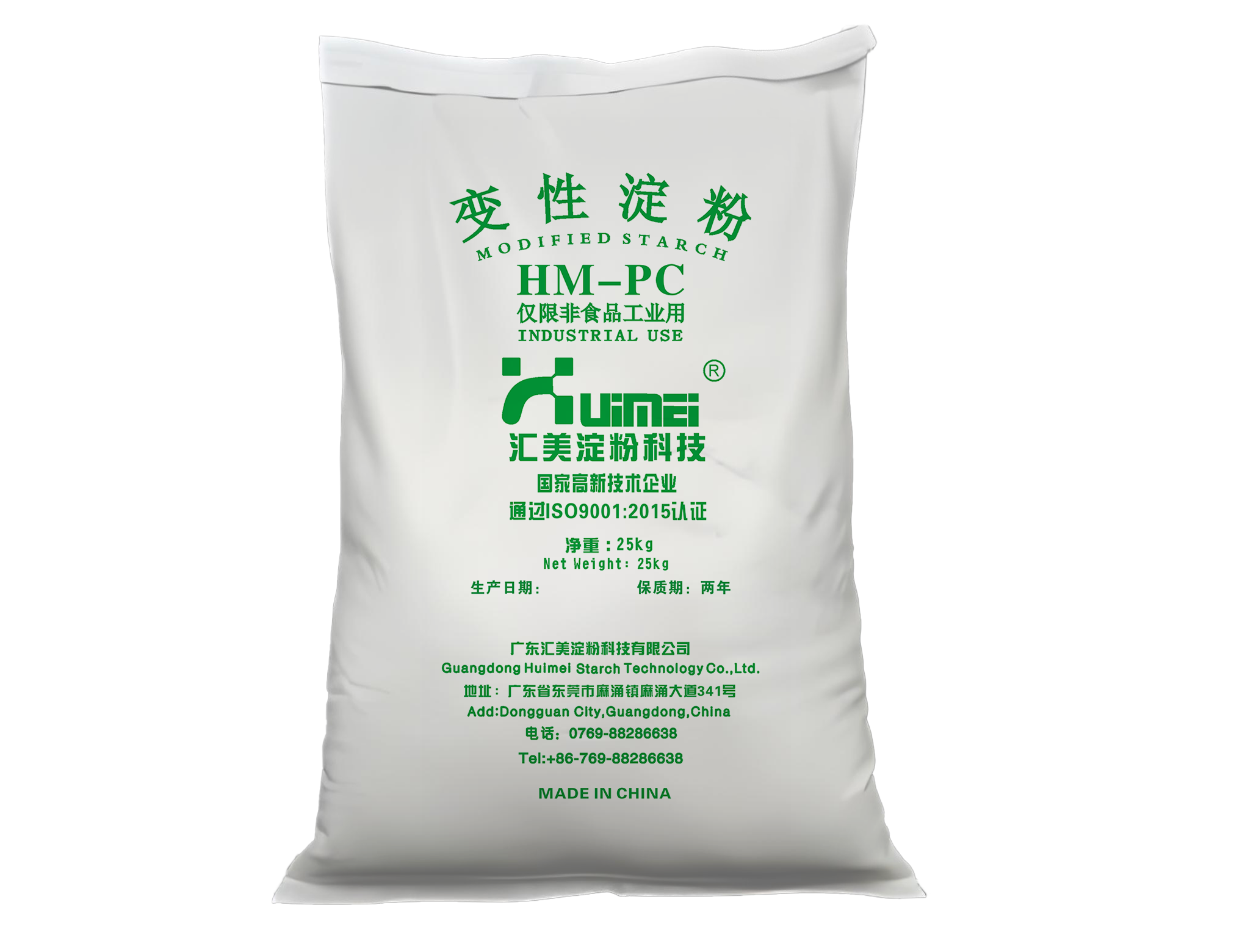
Get High‑Performance Cationic Starch from Huimei Starch
At Guangdong Huimei Starch Technology Co., Ltd., we supply cationic starch with precisely controlled substitution degrees (including DS 0.02, 0.04, 0.06, and custom grades). Our products are:
- Produced in a certified facility
- Suitable for paper, textile, and wastewater treatment applications
- Backed by technical support from our R&D team
If you are looking to improve color fixation, reduce dye migration, or switch to a greener fixing agent, contact us for samples and formulation guidance.
References
- Chen Tong, Sheng Jie, Han Jiyou, et al. Effect of Cationic Starch as Dye Fixing Agent on Color Fixation on Paper Surface. China Pulp & Paper, 2019, 38(3): 25‑29. DOI: 10.11980/j.issn.0254‑508X.2019.03.005
- 【Print】
- 【Collection】
- 【Returns】



CONTACT US
Tel : +86 07698828 6638
Mobile/WhatsApp: +86 13650202730
E-mail : hmdfkj@126.vip.com
Add : Machong Dadao Road,
Machong Town,Dongguan,
Guangdong, China
Guangdong Hui Mei Starch Technology Co., Ltd.Guangdong ICP 12,062,607th No. 1 Copyright©all Rights Reserved